Less Mess, More Yes: Easy Decluttering for Busy Families
Less Mess, More Yes: Decluttering for Real Family Life
Family clutter builds fast: toys migrate, paper piles multiply, and daily routines get harder than they need to be. The goal isn’t a picture-perfect home—it’s a home that’s easy to reset. With a few kid-friendly habits and simple storage limits, cleanups get faster, mornings run smoother, and shared spaces feel usable again.
Why family clutter keeps coming back
Most households with kids don’t have a “mess problem”—they have an “inflow and follow-through” problem. A few common patterns keep clutter returning:
- High-volume inflow: school papers, party favors, hand-me-downs, and impulse toys arrive faster than they leave.
- Unclear “homes” for items: when storage is vague, everything becomes a temporary pile.
- Kid development stages: interests change quickly, so yesterday’s favorites get abandoned. (It’s normal—kids’ needs and skills shift with age; see the CDC’s child development overview.)
- Decision fatigue: too many items create too many choices for adults and kids.
- All-or-nothing cleaning: big weekend purges don’t stick without small daily resets.
A realistic decluttering mindset for homes with kids
The most sustainable approach is practical: set a baseline you can maintain on your busiest days. That baseline becomes your family’s “calm default.”
- Aim for “easy to reset,” not “always spotless.” A home can look lived-in and still feel calm.
- Set a visible baseline: clear floors in walkways, clear kitchen counters, and a calmer entryway.
- Make it about access and time: less searching, fewer arguments, faster mornings.
- Use simple rules kids remember: one bin per category, one shelf per project, one hook per backpack.
- Decluttering is a skill: practice in short bursts so kids learn how to decide and maintain.
When the environment is less chaotic, the household mental load often drops too. If stress is running high, it can help to understand how stress affects attention and decision-making; the American Psychological Association’s stress resources offer a helpful overview.
Quick-start plan: 30 minutes a day for one week
Consistency beats intensity. Set a timer for 30 minutes, stop when it ends, and let “good enough” count. Here’s a family-friendly one-week reset that creates quick wins without triggering an all-day overhaul.
| Day | Focus area | Goal | Stop point |
|---|---|---|---|
| 1 | Entryway | Clear walking path + hooks/bins | When shoes and bags have a dedicated spot |
| 2 | Kitchen counters | Only daily tools stay out | One paper tray + clear prep space |
| 3 | Living room | Toys contained, surfaces usable | All toys fit in assigned container |
| 4 | Bedrooms | Floors clear, laundry simple | One hamper + one donation bag per room |
| 5 | Bathrooms | Less backup clutter | One bin for daily items, extras stored |
| 6 | Paper | Reduce piles | Action items in one folder, rest recycled/filed |
| 7 | Toys | Lower volume, easier play | Rotation box created or donation bag filled |
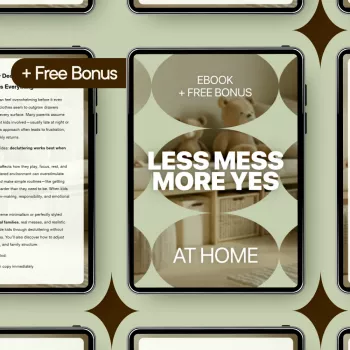
If you want a structured, step-by-step approach designed specifically for family routines, Less Mess More Yes at Home: A Decluttering Guide for Families With Kids – Simplify Your Home and Life is built around repeatable resets, simple storage limits, and kid-friendly systems.
Kid-proof systems that actually stick
“Organizing” fails when it’s too complicated to maintain. The most reliable systems are visible, simple, and sized for kids’ capabilities.
- Match storage to age: open bins for younger kids; labeled shelves and drawers for older kids.
- Store by where it’s used: keep art supplies near the art spot, not across the house in a “perfect” craft zone.
- Let containers set the limit: a full bin means it’s time to choose what stays—no extra bins added.
- Create a daily 5-minute reset: timer + music + a short job list (floor, couch, table, bins).
- Make “return to home” the default: every item needs a reachable, obvious home a child can manage.
- Keep two helper bins handy: a donation bag and a “relocate” basket for items that belong elsewhere.
For families, routines matter as much as storage. The American Academy of Pediatrics’ family routines resources reinforce how consistent habits support smoother days—decluttering is no different.
Room-by-room decluttering without the overwhelm
Toys
Start with what makes the biggest visual impact. Keep favorites and high-use items accessible, and rotate the rest. When fewer items are out, play gets deeper and cleanup becomes realistic.
Clothes
Simplify drawers so kids can find what they need. Keep a small “maybe” bag for items that don’t fit or aren’t worn—revisit it monthly instead of re-deciding daily.
Books and crafts
Kitchen
Paper
What to do with sentimental kid stuff (without keeping everything)
Maintaining the calm: routines that protect your progress
If low energy makes it hard to stay consistent, consider building a simpler midday routine that supports steadier focus. The Midday Energy Crash Mystery – Post-Meal Fatigue Guide, Digestion & Energy Balance eBook, Smart Eating Digital Download is a practical resource for families looking to reduce post-lunch sluggishness that can derail afternoon resets.
A practical guide built for family life
FAQ
How do you declutter when kids don’t want to get rid of anything?
Use container limits so the space makes the decision, and offer choices (“Pick 10 to keep out”) instead of yes/no questions. Start with broken, incomplete, or clearly unused items, and use toy rotation so letting go doesn’t feel permanent.
What’s the fastest way to make a messy home feel better today?
Clear floors in walkways first, then reset the entryway, contain toys into one bin, and create a single paper inbox. Visible open space reduces stress quickly and makes the next cleanup easier.
How many toys should kids have out at once?
Let space decide: choose one or two easy-to-manage containers for “out now” toys and store the rest for rotation. If cleanup regularly takes longer than 10 minutes, the out-now set is still too big.








Leave a comment