Build a Spinning Satellite: DIY STEM Kit for Kids
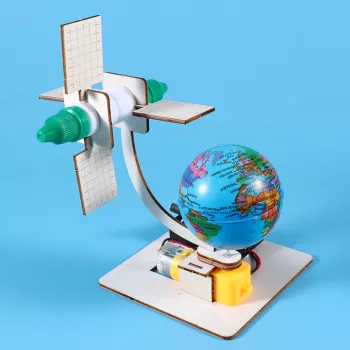
DIY Orbiting Satellite Science Kit for Kids: Build, Spin, and Learn Space Science
A hands-on satellite model turns big space ideas into something kids can build and test on a tabletop. A kit-style activity like this supports STEM learning through simple mechanics, motion, and problem-solving—while keeping the experience playful, screen-free, and easy to repeat with new “missions” and experiments. For more guidance, see What Is an Orbit?.
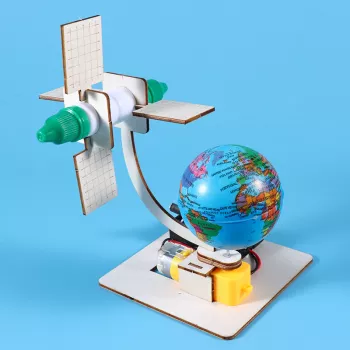
For families and classrooms that want a clear start-to-finish project (with a moving result at the end), an orbiting satellite build is a satisfying way to connect creativity to real science. If you’d like a ready-to-go option, the DIY Orbiting Satellite Science Kit for Kids – Fun STEM Learning Toy is designed for assembling, spinning, and re-testing—so kids can keep improving what they made. For further reading, see Solar System Model Kit For Kids – Paint & Build Planet Models With ….
What Makes an Orbiting Satellite Model So Engaging
- It transforms abstract space concepts into a physical build kids can touch, tweak, and modify.
- It encourages curiosity through a simple loop: try, observe, adjust, and try again.
- It fits well for family time, classroom stations, science fairs, and rainy-day activities.
- It supports focus and follow-through because the end result moves and demonstrates a clear idea.
That “movement payoff” matters: when kids see the model spin smoothly (or wobble and stall), they get immediate feedback. That feedback naturally leads to questions like “What changed?” and “How can I make it better?”—which is the heart of hands-on science.
Skills Kids Practice During the Build
- Fine-motor skills: assembling smaller parts, aligning pieces, and pressing connections together carefully.
- Engineering habits: following steps, checking stability, and troubleshooting wobble or friction.
- Science thinking: making predictions about speed, balance, and motion before testing.
- Math-ready concepts: counting rotations, comparing speeds, noticing patterns, and connecting cause/effect.
- Communication: explaining how the model works and what changes improved it.
These skills don’t require advanced vocabulary to be meaningful. Even a simple observation like “It spins longer when the arms are even” is a real scientific conclusion—especially when kids can repeat it and show evidence.
How the “Orbit” Idea Can Be Explained Simply
In real life, a satellite stays in orbit by continuously moving forward while gravity pulls it inward—creating a constant “falling around” effect rather than falling straight down. NASA’s student-friendly explanations of what an orbit is and what satellites do can help connect the model to the real world.
A tabletop model can’t reproduce gravity and space perfectly, but it can demonstrate the building blocks of orbiting motion: circular movement, rotation around an axis, balance, and how small changes affect stability. That’s a powerful bridge from “space is huge” to “I can test part of this idea with my hands.”
Once kids see the model spin, it’s a natural step to connect motion to real satellite jobs—weather monitoring, GPS, communication, and Earth observation. NASA Space Place also offers a clear kid-friendly overview of what a satellite is, which pairs nicely with a build-and-test activity.
Quick Setup and Safe, Smooth Building
- Build on a clear, flat surface and use a small tray or shallow box lid so parts don’t roll away.
- Sort pieces before starting to reduce frustration and speed up assembly.
- Check for snug connections; loose joints often cause wobble or inconsistent spinning.
- Adult help is useful for younger builders, especially for tighter-fitting parts.
- Store the finished model in a box or bin to keep pieces together between sessions.
If the motion feels rough or the spin stops quickly, treat it like a clue: look for misalignment, rubbing parts, or pieces that need to be reseated. That small “debugging” moment is often where the best learning happens.
Activity Ideas That Extend Learning After It’s Built
The build is only the beginning. After assembly, kids can run simple experiments that feel like real testing—because they are. Use a timer, a notebook, and a few “one change at a time” trials.
Simple Experiments to Try with a Satellite Model
| Experiment | What to Change | What to Observe |
|---|---|---|
| Spin consistency | Repeat the same start motion 3 times | Differences in number of rotations and smoothness |
| Balance and wobble | Shift attachments or re-seat parts | Reduced wobble; steadier motion |
| Friction check | Try a different surface or adjust alignment | Faster/slower motion; earlier stopping |
| Design upgrade | Add a paper “solar panel” or “antenna” | Changes in balance and motion; improved storytelling |
- Rotation test: time how many spins happen in 10 seconds and compare trials.
- Balance challenge: adjust the arms or attachments to reduce wobble and improve smooth motion.
- Friction experiment: observe how motion changes on different surfaces or with slight alignment changes.
- Mission design: invent a satellite purpose (weather, navigation, imaging) and present it like a mini science briefing.
- Vocabulary builder: satellite, orbit, rotation, axis, friction, balance, model.
For a classroom-friendly extension, have kids record one prediction, one change they made, and one result they can demonstrate. It keeps the activity hands-on while building early lab-report confidence.
Who This Science Kit Works Best For
Featured Picks (In Stock)
- DIY Orbiting Satellite Science Kit for Kids – Fun STEM Learning Toy — a build-and-play activity that introduces space-themed motion through a moving model and repeatable experiments.
- The Midday Energy Crash Mystery – Post-Meal Fatigue Guide, Digestion & Energy Balance eBook — a quick digital read for grown-ups who want practical routines that support steady energy during busy days of learning and play.
FAQ
What are some good DIY science experiment kits?
Great DIY science experiment kits let kids build a working model they can test and improve—like projects focused on motion, simple circuits, magnets, or simple machines. Space-themed builds such as an orbiting satellite model are especially fun because kids can measure results by timing spins, adjusting balance, and comparing trial runs.








Leave a comment